
Urgent medical transport during emergencies
The service provides medical assistance to patients who cannot be treated at the emergency site
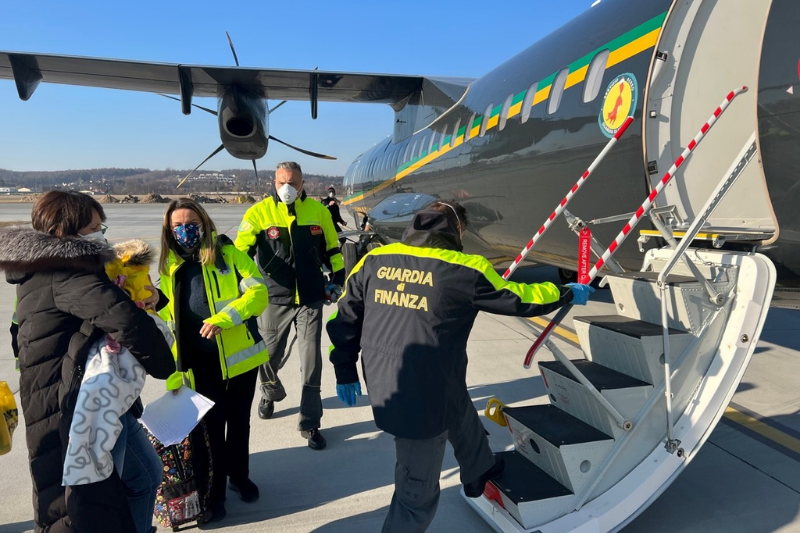
During emergencies, urgent medical transport may be necessary to provide assistance to patients, ensuring prompt admission to medical facilities and appropriate care during the transfer.
The international term to define this service is MedEvac (Medical Evacuation). It refers to the transportation of injured patients or individuals in need of medical care, whether urgent or non-urgent, from one location to another ensuring they receive adequate medical assistance.
MedEvac may be activated mainly under the following circumstances: when urgent medical aid is required in remote areas or locations with poor road accessibility; when healthcare facilities that are partially or fully inaccessible, or no longer operational must be evacuated; when it is necessary to relieve pressure on healthcare facilities experiencing a patient influx exceeding their operational capacity.
Transportation may be provided by land, sea, or air.
Air medical transport, or MedEvac, may take place using fixed-wing or rotary-wing aircraft. When fixed-wing aircraft are used, medical transport must be "combined", including both air and ground transport. When rotary-wing aircraft, such as medical helicopters, are employed, patient recovery and drop-off may occur directly from the pickup point to the receiving hospital.
Air MedEvac operations may employ either specific aircraft for medical assistance or other aircraft suitably adapted for this purpose.
Since the outset of the Russian-Ukranian conflict, Italy has activated a dedicated MedEvac service for patients from Ukraine located in neighboring countries, using transport assets of the National Civil Protection Service’s operational structures, or privately donated flights, staffed with medical personnel provided by the Regions.
MedEvac operations for transporting patients from Ukraine due to the conflict involve two medical teams with distinct roles and responsibilities:
Medical team for patient transfer. During transport, this medical team ensures care for patients and accompanying persons, including unaccompanied minors, and coordinates patient handover to Regional healthcare staff at the hospitals identified by the Cross-Remote Centre for Health Rescue Operations.
Medical assessment team (Scouting Team). This team operates in the patient’s area of origin: it identifies patients, assesses their medical condition, determines transport priorities and feasibility, and provides pre-embarkation care while ensuring proper handover to the medical team responsible for accompanying the patient during transfer.
In addition to MedEvac, the DisEvac (Disability Evacuation) module operates as a specialized service for the protected evacuation of vulnerable individuals, people with disabilities, or special needs.
In Italy, the Misericordie DisEvac module is responsible for transporting vulnerable individuals over long distances, whether able to walk or not, in wheelchairs or on stretchers, ensuring they receive the required assistance.