
Response model
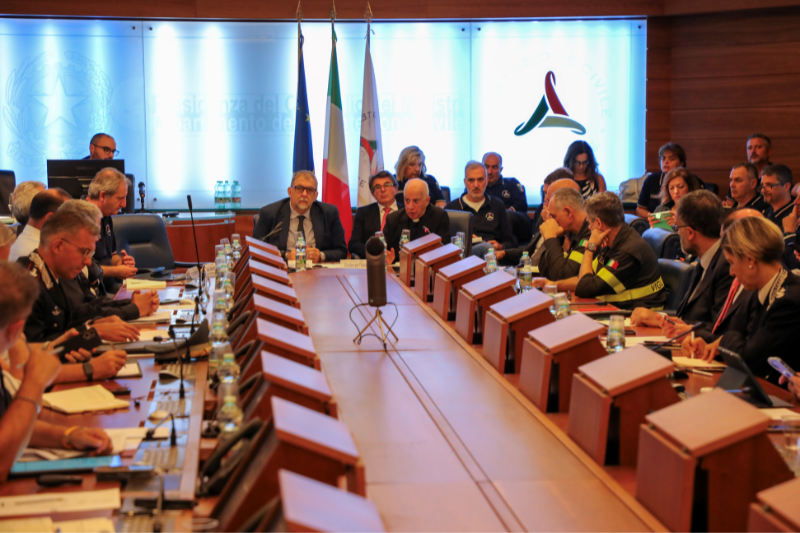
One of the most challenging objectives of EXE PO 2026 is interinstitutional coordination among the many entities involved in flood management. In addition to the activation of the national and regional warning systems—with the involvement of the Centres of Competence—the plan also calls for the activation and organization of coordination centres at various territorial levels across the four regions involved, with a focus on testing communication flows.
During the exercise, the Civil Protection Department is required to activate the Crisis Unit, which will provide support and liaise with the coordination centres operating in the field. On this occasion, the Civil Protection Operations Committee will be convened in real time, relying on the Italy Situation Room to gather information from the area affected by the event and to maintain constant communication with other national, regional, and local operations rooms.
There is also a link with the European Commission’s Emergency Response Coordination Center (ERCC) to notify the Commission of the event, exchange information on available resources, and handle any requests for assistance from other Member States, using the secure CECIS - Common Emergency Communication and Information System communication network.
In the event of flooding involving river basins that span multiple regions—as is the case with EXE PO 2026—the Department promotes and coordinates, including through the network of Operations Centres, the exchange and sharing of information among all stakeholders. The event is managed by the Command and Control Unit (UCC), which serves as the competent civil protection authority for flood management. It is an institutional policy body composed of the Presidents of the Regions, or their delegates; the Minister of the Environment and Energy Security, or a delegate; and the Presidency of the Council of Ministers—the Head of the Civil Protection Department or a delegate. Based on information provided by the Regional Technical Hydraulic Coordination Centres and with the support of the AIPO, and taking into account current and projected scenarios, the UCC is tasked with making decisions regarding the actions necessary to address and, if possible, mitigate the effects of the flood event, in order to protect human life, property, settlements, and the environment. The UCC is convened by the Department either on its own initiative or at the request of one or more affected regions.
During the exercise activities, coordination is carried out by the Regional Operations Rooms (SOR) of Piemonte, Lombardia, Emilia-Romagna, and Veneto, which communicate with the Prefectures, their territorial offices, and the municipalities. If established, the Regional Technical Hydraulic Coordination Centres also operate, in coordination with the UCC and their respective SORs.
In the Prefectures-UTG, Rescue Coordination Centres (CCS) are activated and, if deemed necessary, the respective Traffic Operations Committees (COV) are convened. In addition, the Provinces and the Metropolitan City of Torino along the Po River play a role in coordination, planning, and logistical support, acting as intermediate bodies between the Region and the municipalities.
Municipal Operations Centres (COC) are activated where field or command-post exercise activities are planned.